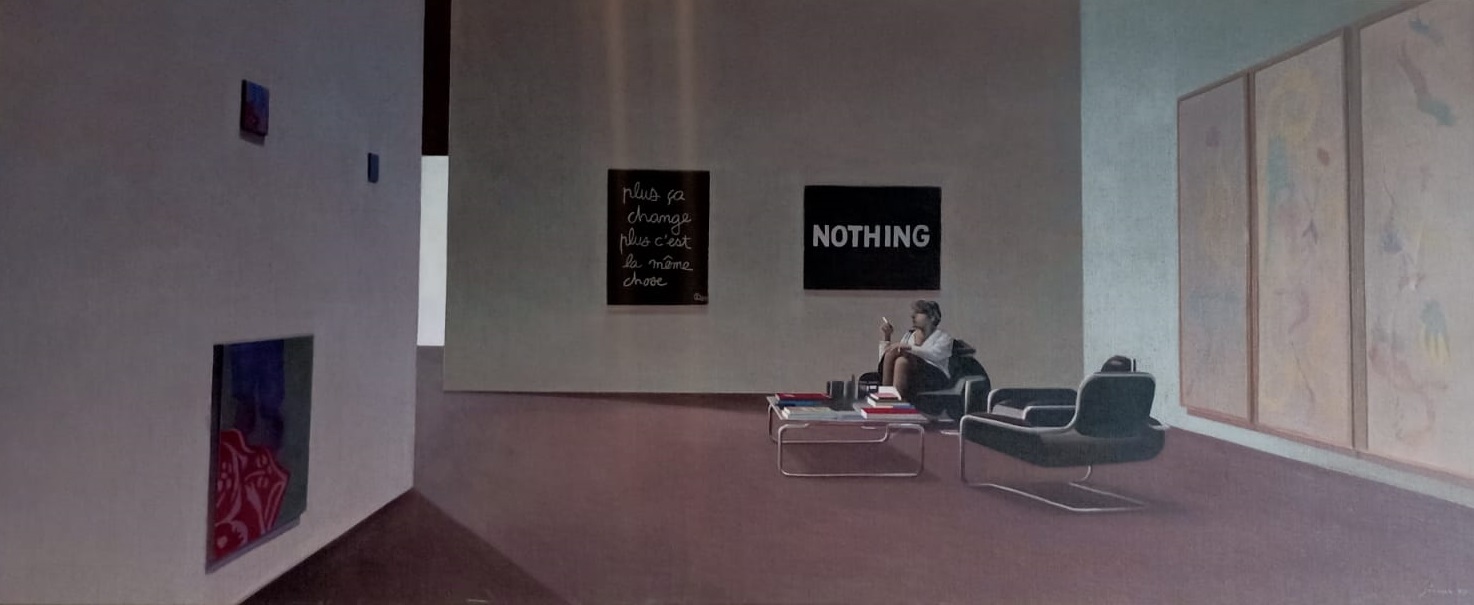
Nothing
IXELLES museum
BRUSSELS
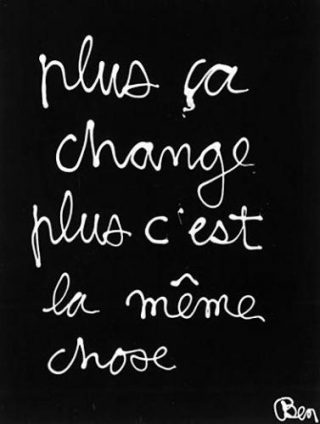

CULTURAL CONTEXT
Starting with his painting "Nothing"
Séroux enters into a resonance with Flaubert
Flaubert's style in his novel
Madame Bovary manages to make
a "book about nothing"
a true masterpiece.
In its various component points,
nothing happens, or more precisely,
nothing but the wear and tear of time
and the madness of women and men
in the face of emptiness. The challenge, therefore, is to
transform these "nothings" into a serenity
serving as a masterpiece.
Its principle:
the author must be absent from the work.
Actions and characters are not described
by a narrator;
they are seen by the characters themselves.
Free indirect style erases narrative boundaries
and protagonists.
This allows for infinite shifts in perspective
and the disappearance of the novel's subject.
The details, the "non-place" of
the plot's unfolding, eliminate emotion
in favor of a form of irony
that creates distance.
The use of clichés, stereotypes,
and other received ideas
contributes to the same effect.
Cultivating Nonsense and Nothingness
The generalized relativity of viewpoints
sets in motion a perpetual doubt
that refuses to conclude.
The most beautiful works are those
with the least amount of substance;
the closer the expression comes to the thought,
the more the word clings to it and disappears,
the more beautiful it is.
Gustave Flaubert,
letter to Louise Colet,
January 16, 1852
It is not a question of rejecting meaning.
It is a question of showing
the profound intuition that there is no meaning.
“I believe only in the eternity of one thing,
that is to say, of Illusion, which is the true truth.
All others are merely relative” (January 15, 1847),
“that which has no meaning has a meaning
superior to that which does”
(July 1845).
This explains his famous statement:
“What seems beautiful to me,
what I would like to do, is a book
about nothing […]
that would stand on its own
by the internal force of its style.”
January 16, 1852.
In Séroux’s perspective here,
nothing happens. Nothing but the wear
and tear of time and the madness
of men and women.
The challenge lies in transforming this
“nothing” into a serenity that serves
as a masterpiece.
BACK TO RESEARCH MENU SUMMARY
SUMMARY
A / Absence / A.I. / Ambitions / ARTS B / Belle de jour / Bovary C / Caldera / Confidences / Consents D / Dreams E / Escapes / Ecstasies / Enjoyments / Exhibitions G / Glutony H / Hallucinations K / King Kong theory M / Madness / Magic N / NIGHT / Night meetings / North / Nothing O / Origines / Overlays R / Rebellions / Rendez-vous / Resentments S / Sirens T / Tourism V / Vices and virtues / Viewers W / Winds
TRIBUTES / Goya / Ingres / Manet / Marlene Dumas / Rops / Rodin /
STUDIES