CONTACT
INTERVIEW &
CRITICS
3 CHAPTERS
CONTACT
THE SITE TEAM
ENHANCING THE INVENTORY
An inventory is underway. If you have one or more works, or if you have a question to ask, you can contact our small team using the form below.
Note : Please fill in the fields marked with an asterisk (*).
1 /
INTERVIEW (in french)
2008 / Tell me about Love
the midnight lover
by Gabrielle Stefanski
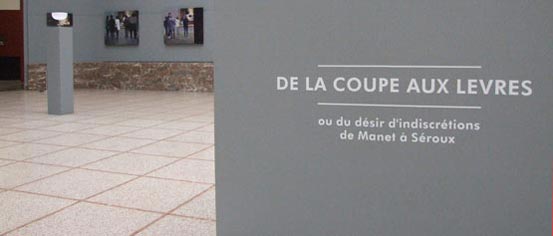

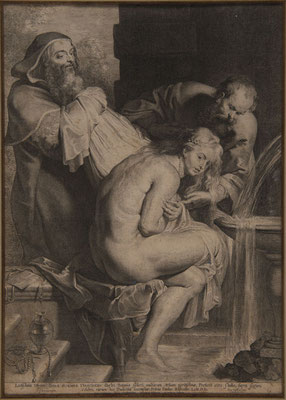

on the occasion of the exhibition
FROM THE CUP TO THE LIPS
or the desire for indiscretion
from Manet to Séroux
2 /
A brief biography
or THE ENIGMA OF A
DELIBERATE ABSENCE
ELSEWHERE
In 1983, Séroux stayed on the island of HIVA OA in the Marquesas - French Polynesia. He returned there later (see his notebooks). He then lived mainly in Paris until 1986.
In 1986, Séroux, alongside Wim Delvoye, Angel Vergara and others, was one of the finalists for the prestigious "Prix de la Jeune Peinture Belge" and exhibited at the Palais des Beaux-Arts de Bruxelles - BOZAR.
The press wanted to meet him. He is nowhere to be found.
HIS LIFE AS A NOVEL
His life was elsewhere, somewhere in the Indian Ocean, on an island between Australia and Mauritius, off the beaten tourist track: Rodrigues.
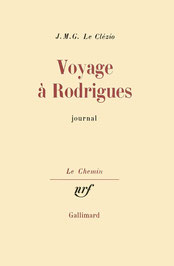
He stayed there with a book in his hand: "Voyage à Rodrigues" by Jean-Marie Gustave Le Clézio, who went on to win the Nobel Prize for Literature.
With a book
Rodrigues Island, Le Clézio described it as "emerging from the sea, carrying with it the history of the first eras: blocks of lava thrown, broken, flows of black sand, powder where the roots of vacoas cling like tentacles".
AN EXISTENTIAL QUEST
The writer went there to write the story of his grandfather's quest in situ:
"Isn't it like the Wells character, trying to go back in time?
He wondered how this man had been able to endure such living conditions for so many years, such solitude, how he could define his obsession, define in words "this gold-diggers fever", "language is a secret, a mystery"...
This obsession, this exhausting search for a hypothetical treasure, is above all a quest for lost happiness.
Le Clézio is struck by the contrast between his grandfather's solitary obsession and the total war of 14/18 raging in Europe.
The contrast, too, between one man's unattainable dream and the destruction of an ancient world.
But even on this tiny island, war is going to impose itself through the shadow of its disturbing presence.
THE QUESTION
How can we forget the world," he writes, "can we seek happiness when everything speaks of destruction?"
And so it is: "The world is jealous... it comes to find you where you are, at the bottom of a ravine, it makes its rumour of fear and hatred heard...".
J.M.G Le Clézio, the grandson, also feels cheated by this journey:
"Now I know. We don't share our dreams".
The life of an artist is so special that most of the time it is lived alone.
In 1983, Séroux spent several months in this state of mind on the island of HIVA OA in the Marquesas - French Polynesia. He returned there later (see his notebooks). He then lived mainly in Paris until 1986.
In 1990, he moved to Tokyo, where he took part in a group exhibition of Belgian-Japanese in situ contemporary art, for which France Borel wrote a book. Their shared interest in India, humour and distancing themselves from Western rails made them very close friends until France's death in Mauritius in 2021.
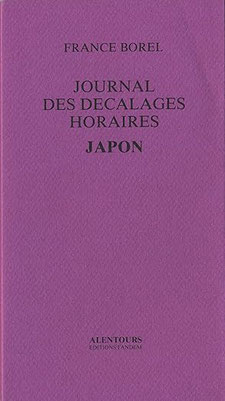
France Borel too would one day decide to resign from social life and the management of the Ecole Supérieure d'Art de La Cambre to travel the world and find herself there.
She and he shared this sense of withdrawal.
In 1991, he took part in a group exhibition at the Musée Art & Histoire in Brussels. He had two solo exhibitions in Tokyo, but did not go there.
In 1996, he was a finalist in the Europe Prize for Painting awarded by the city of Ostend, alongside Michaël Borremans.
From 1997, the Fred Lanzenberg gallery showed his work for ten years, with four exhibitions, including a one-man show at the Art Brussels fair. A painting was acquired by the Musée d'Ixelles.
In 2008, an exhibition at the Musée des Beaux-Arts de la ville de Tournai: Séroux - Manet / De la coupe aux lèvres.
In 2011, his last exhibition at Fred Lanzenberg was about the gallerist's refusal to open up beyond the expectations of his clientele.
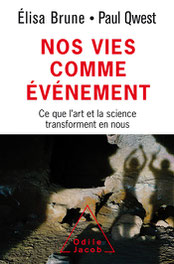
In 2019, Éditions Odile Jacob will publish an essay he co-wrote with Elisa Brune under the heteronym Paul Qwest, about what art and science transform in us: "Nos vies comme événement" ("Our lives as events").
Her life in reverse
His artistic temperament implies that something has to be lived in reverse: it's the opposite of a quest - it just so happens that... - and a gap, as if, to grasp the dimensions of the earth, you also had to be able to look at it from the moon.
Painting is a desire not for lack, but for more. Like the raw artists, he has no social or material ambitions.
Things first happen in life, then are translated in the studio, with no other intention than to attempt various transpositions, shown to amateurs, and present in a few museums and collections.
3 /
Press Critics
1995 /
The gaze
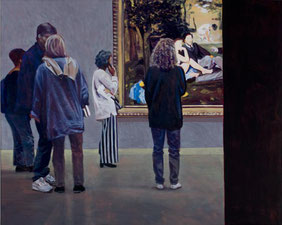
Since the 15th century, painters of reality have always strived to reconcile the faithful rendering of the subject with respect for the inherent laws of pictorial language.
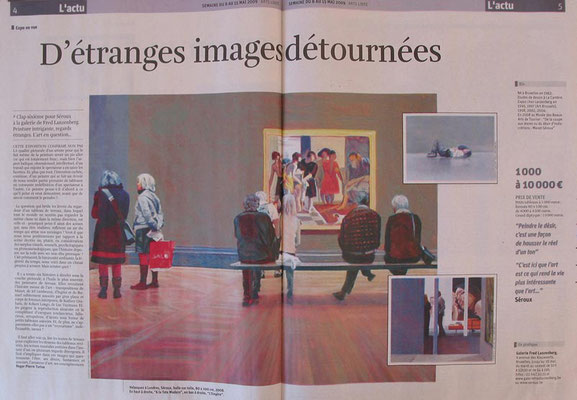
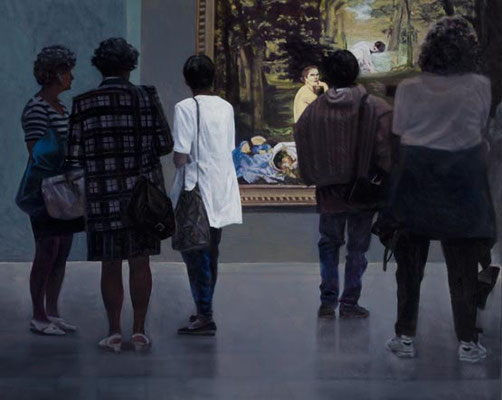
In this spirit, Séroux has already presented urban views, integrating what the eye sees of a modern world with the graphic interpretation that the hand can render. In his recent work, he reverses this approach. It is less about showing a point of view than about showing 'from the painter's point of view'.
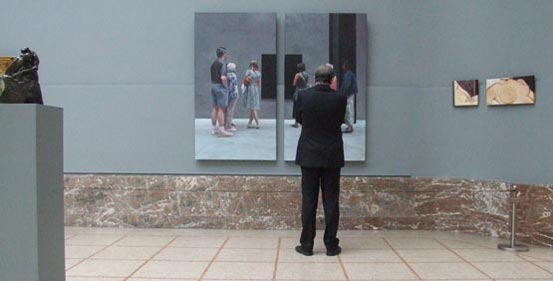
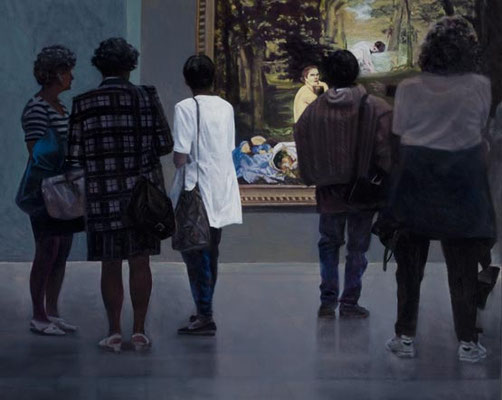
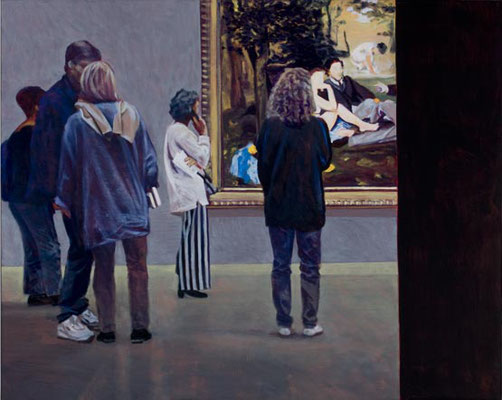
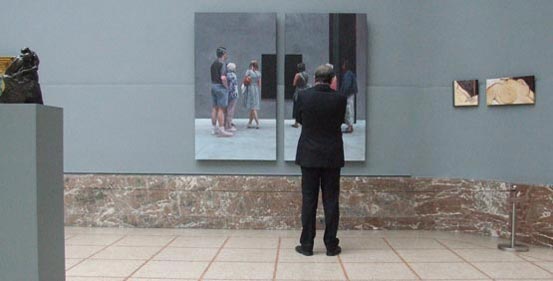
Echoing the numerous visual traps that run through history, from Van Eyck to the Hyperrealists, Séroux offers here a series of scenes that speak of the pleasure of seeing and capturing the moment of observation. While he doesn't truly employ mise en abyme, he comes very close: the visitor observed, who himself contemplates a painting within a painting.
A double play of the gazes of things seen. The painter is absent; He is nonetheless indiscreet: he observes his subject from behind, at a safe distance, sometimes even concealing himself behind a museum wall. As with Vermeer, the eye bursts into a universe, that of an attentive, dreamy, or distracted visitor. Added to this is a museum reference: the object of his gaze is neither a letter nor a window, but a painting. The painting is thus at the center of the museum, destined to be seen. He makes it the very object of his work, and thereby invites various levels of interpretation.
By repeatedly referencing an old master, Séroux evokes the countless copies in museums, while simultaneously affirming pleasure in an allusive way. This freedom is also found in the construction of a frontal geometry, in the very precise selection of tones, and in the arbitrary collages of monochrome planes and illusionistic scenes. It is, in fact, a subject that is captured, with the intention of recreating a space, sketching a pose, and distributing light within it. While everything is fiction, since each element is recreated, the moment nevertheless strives for verisimilitude.
Séroux evokes Hopper, a realist when he captures a human being in a space conceived as a backdrop, yet abstracted through his simplification. The series of paintings on display forms a collection of sequence shots and framing reminiscent of cinema or photography: each time, they juxtapose the immutable space of a museum with snapshots of a visitor's gesture.
This ambiguity is something the viewer will experience when, alone before a Séroux painting, they too find themselves observed by the indiscreet eye.
One thinks of Tournier. Through perspective, the drawing recedes toward a distant horizon, but it also advances and imprisons the viewer…
The door opens onto infinity, but you find yourself definitively compromised.
Vincent Cartuyvels / Art Historian
Brussels | June 1995
1998
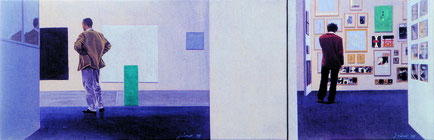
"A patient surveyor of exhibition venues such as museums and galleries. Seroux's technical mastery gives his paintings an impression of photographic reality. Today, the painter has given up anecdotes (identifiable spectators and famous works), and favours empty, almost anonymous places. A subtle tension is established in the work: do we see an identifiable, cold image, or a construction of abstract forms?
At the end of the day, we look inside ourselves and are finally able to distinguish from all that had seemed real until then, the only possible reality: that which we invent".
X, Les images inquiétantes de Seroux, in: Le Vif l'Express, February 1998.
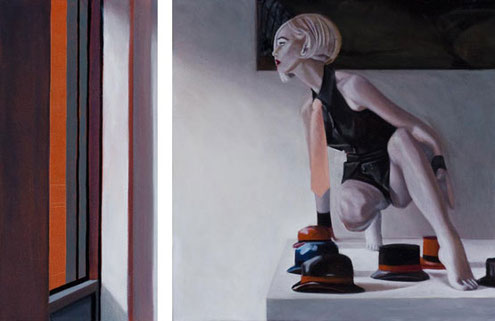
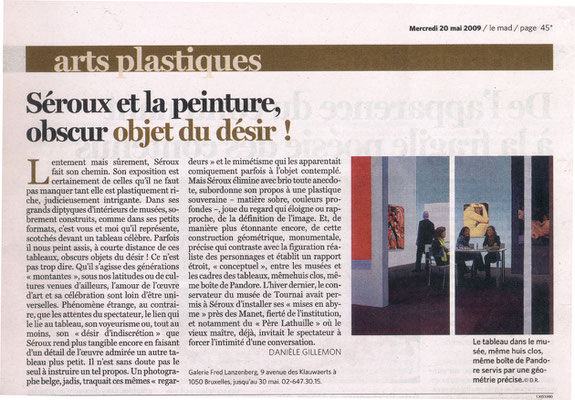
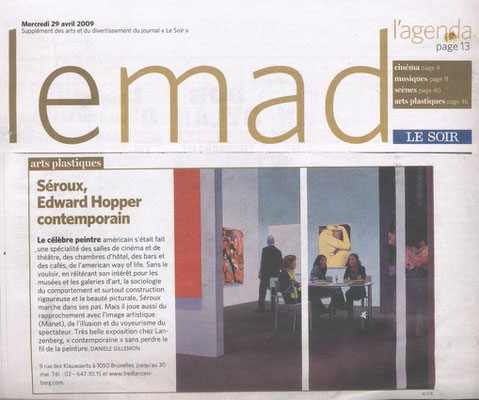
Séroux's appearance on the walls is relatively recent. This young Brussels painter won a competition organised by the commune of Woluwé. Amid the hodgepodge of entries that are the law of the genre, oscillating between well-worn abstraction, straightforward daubings and post-conceptual impulses, his approach to painting won the unanimous approval of the jury.
At least Séroux stands out from the crowd with his accomplished craftsmanship, painting meticulously-crafted museum interiors, highly constructed and hyper-figurative canvases where the picture rails are the pretext for strict plans whose absolute legibility obviously conceals hidden agendas. The figures who inhabit these spaces, simple visitors bent over masterpieces, are less anecdotal than they are the foils for places and cultural practices that are, all in all, rather strange.
Museums, their users, their educational facilities, painting, its power, its limits imposed by the setting but also by life, in short art in conversation, the subject, after all, is worth another. Without going so far as to say that a philosophical reflection fleshes out these spaces, it is clear that the images are seductive and that they are totally different from the hyperrealism to which we might be tempted to reduce them. Similarly, it is clear that Séroux is a true painter. In fact, nothing could be less photographic or more offbeat than these compositions, which frame frames and break down our relationship with art into neat, straight sections.
Observed through the small end of a spyglass, they do not fall into the trap of derision, but neither are they without irony, particularly with regard to constructed art, the confusion maintained between container and content, the mirror effect, they give rise to a slight vertigo that increases as the artist progresses and measures the dangers of painting that is too systematic. The nested spaces, the interlocking spaces served up by a rich palette and a real pleasure in painting, the abstract planes all contribute more and more to pushing the first degree back into the margins of a broader purpose that turns the consumers of picture rails into unrepentant dream runners.
Danièle Gillemon
Le Soir | February 1998
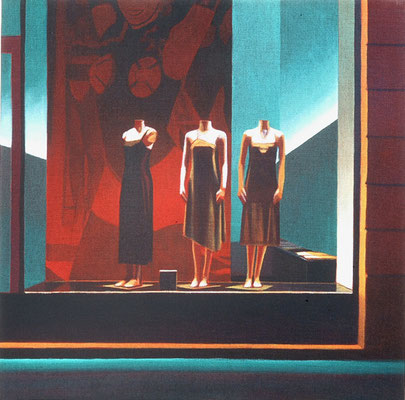
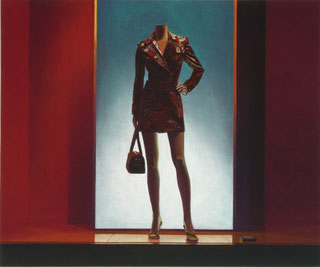
2008 /
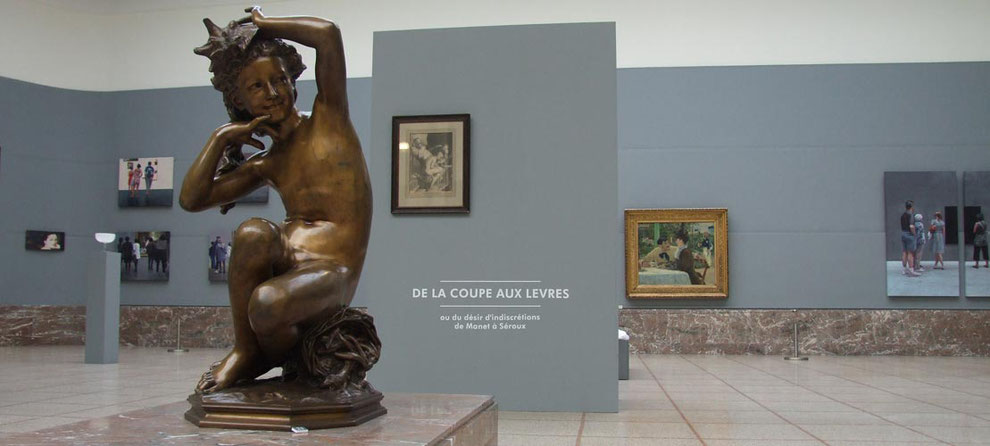
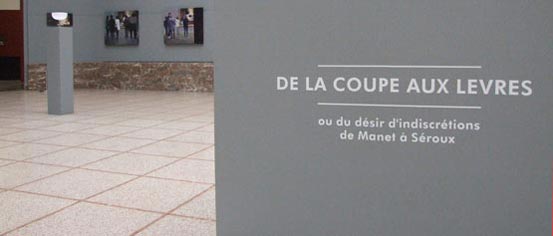
FROM THE CUP
TO THE LIPS
OR THE DESIRE FOR INDISCRETION
BY MANET TO SEROUX
INTRODUCTION
Jean-Pierre De Rycke
Curator of the Museum of Fine Arts
of Tournai / Belgium
From Cup to Lip,
or the Desire for Indiscretions
from Manet to Séroux
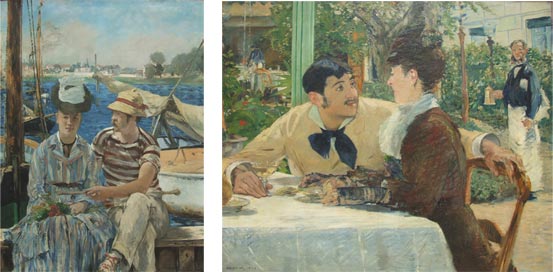
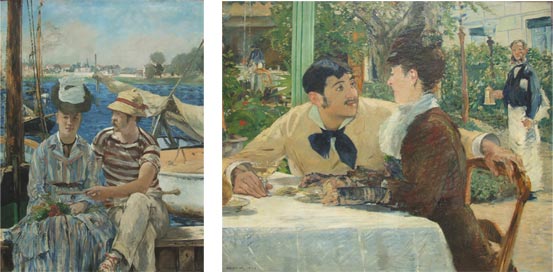
The paintings by Édouard Manet in the Museum of Fine Arts of Tournai share a common thread.
They invite visitors to be the indiscreet witnesses to the desire for encounter between a woman and a man. In these two canvases, "she" appears slightly distant while "he" approaches at an angle. But where does the genius that emanates from these unique works come from? They embody two contractions: on the one hand, the attraction between these couples, and on the other, the way the painting draws closer to the viewer. Through a zoom effect, we are confronted in close-up with the question of the meaning of our desires for indiscretions. And it is as if by intrusion that we witness the movement of the protagonists' desire for encounter.
Manet, for whom "the truth is that art must be the writing of life," engages us directly. As he did with "Olympia" and "Le Déjeuner sur l'herbe," these works literally gaze at us as we approach them. "Paint not the thing itself, but its effect," said his friend Stéphane Mallarmé.
In his famous lecture in Tunis on May 20, 1971, Michel Foucault stated that the painter's genius radically transformed our vision of painting:
"What Manet did was to bring forth, within the very act of representing the painting, those properties, qualities, or material limitations of the canvas that pictorial tradition had hitherto sought to evade or conceal. Manet reinvents, or perhaps invents, the painting-as-object, the painting as materiality, as a colored thing illuminated by an external light, and before or around which the viewer is drawn."
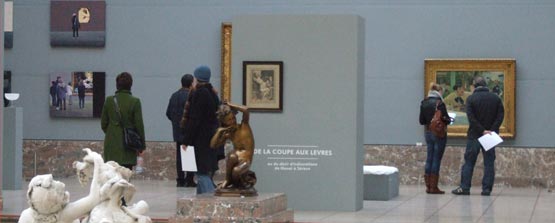
In this exhibition, drawing on the two Manet paintings, my work explores how we perceive our fantasies. I work through juxtapositions of paintings that evoke other works arranged in space. This fluidity of perspective invites us to reconsider our perception through the exploration of thought. The eye then becomes the meeting place of our deepest desires, in particular that of crossing this void which contracts from the cup to the lips in the painting "at Father Lathuille's" where it is literally represented.
THERE'S A LONG WAY
FROM THE CUP TO THE LIP
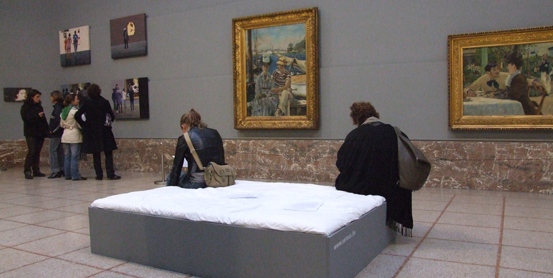
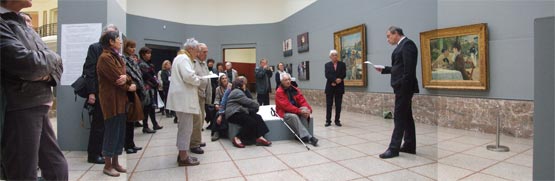
What could it be about Manet that so fascinated Séroux and led the Brussels painter to place him "in context," as they say, as we have the opportunity to discover today at the Tournai festival "Art in the City"?
Chance or fate—or rather, providence—first and foremost, since the Tournai Museum of Fine Arts is, in fact, as is still too often overlooked, the only place in Belgium that houses works by Manet. And what works they are!
Since these are simply two of the painter's most celebrated works, created at the height of his powers and in full command of his craft, they are perhaps two milestones and undeniable landmarks in the history of modern painting. The two canvases, flooded with color and light, that you see before you—"Argenteuil" and "Chez le Père Lathuille," dating from 1874 and 1879 respectively—can be considered among the precursors of Impressionism.
What could be more natural, then, than for our "Prince Charming" to set his sights entirely on our "Sleeping Beauty"—I'm referring to the museum—still in search of resurrection?
A certain idea of "encounter" and seduction then emerged—the origin of the title chosen by the artist, deeply inspired by philosophy and literature, for his installation.
Just as Manet loved to intrude on the intimacy of budding couples with the keenness of a stolen glance, like a paparazzi of the Belle Époque, Séroux scrutinizes the privileged encounter between two contemporary individuals, an inevitable prelude to a more intimate relationship, the ultimate, though sometimes unspoken, objective of any courtship.
Such is life! Both artists, in their own way, extend the theme of "gallant conversation," or flirting, to put it more bluntly, so intrinsic to a whole tradition of painting, even of "culture," French if not "Francophone," and so wonderfully initiated at the beginning of the eighteenth century by Antoine Watteau, the painter from Valenciennes, whose collection is also, as a new revelation, held in the Musée des Beaux-Arts in Tournai, a dazzling selection of his work.
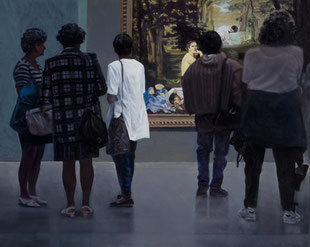
But while Manet immersed himself in the lives of his contemporaries, becoming one of their witnesses, or rather, one of their privileged "voyeurs" in the surrounding atmosphere of Parisian gaiety and frivolity, Séroux chose precisely his antithesis, in a way:
one of the quintessential places removed from the teeming life of nature or the city, a kind of compartmentalized and structured temple where, more often than not, a cult of beauty and contemplation is practiced, with or without pretension: the museum. And the roles are thus reversed.
This time, it is the artworks themselves, hanging on the walls, that serve as scenery, backdrops, or mirrors for the affinities that seek, observe, or form within the hushed world of contemporary exhibition spaces.
A reflection of two profoundly different eras, despite a certain superficial hedonism that might unite them: optimism, lightness, and apparent carefree abandon on one side;
A muted unease about the other, a disquiet, a sense of confinement, and the disenchantment of a society that is almost too perfect, having reached the height of its material prosperity, certainly, but at the very core of its ideals—I haven't spoken of ideology—and its innocence, where pure sexuality—another form of impatient consumption—has now definitively taken precedence over reverie and feeling.
But the charm is not yet definitively extinguished, I sense it, and to revive it, I invite you all to rush from lips to glasses!
October 2008
2009
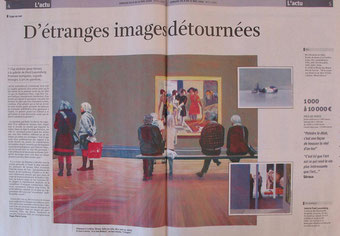
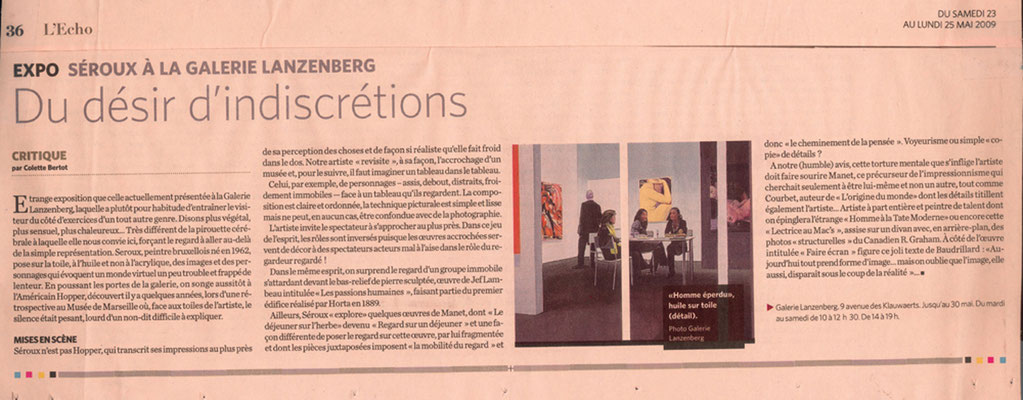
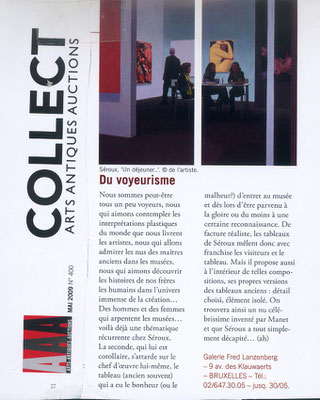
INTRIGUING PAINTINGS, STRANGE LOOKS? ART IN QUESTION...
This exhibition confirms not the pictorial quality of an artist for whom the very act of painting would be a poor substitute (which is totally untrue), but rather the playful, obsessive, intellectual aspect of a work that challenges the viewer to grasp its facets. And, above all, the hidden, ongoing intention of a painter who makes it his duty to involve us in paintings that are constantly being redefined from one viewer to the next. Does this painter first think about what he is painting and wants to show, before knowing how to paint it?
The question that burns in the mind of the viewer of a painting by Séroux, in which not everyone seems to be looking at the same thing or in the same direction, is this: why does he paint scenes in this way that, while not realistic, reflect a zeitgeist that fires our brains? Does he want us to position ourselves in relation to the scene described or, rather, in consideration of the visual, sensual, psychological or phenomenological surpluses that the story placed on the canvas with its unspoken words provokes? The spring air, the ambient light, the lightness of the weather, here we are in a climate conducive to scrutinising. But what is there to scrutinise?
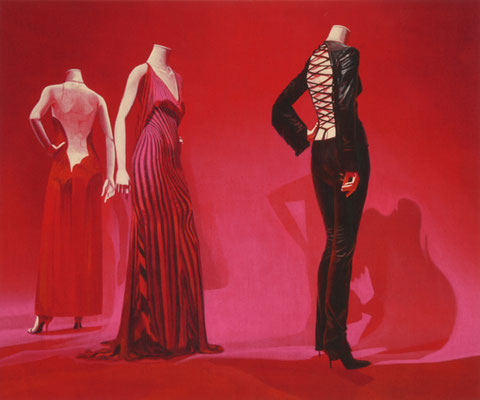
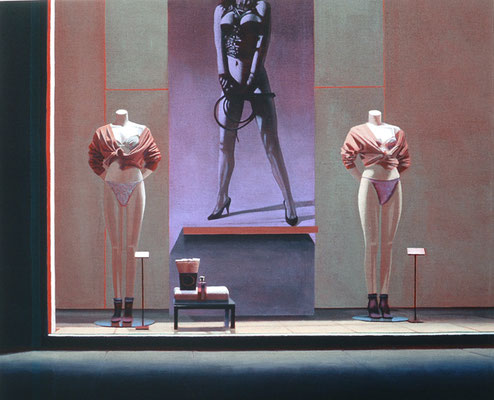
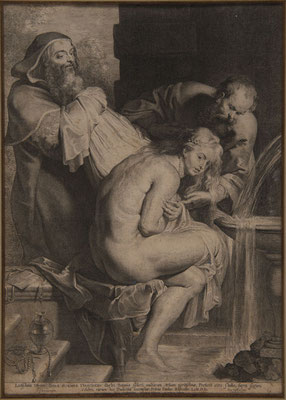
There are thirty-six stories to be found beneath the pictorial layer, mostly in oils, of Seroux's paintings. They revisit the very history of art - the transposition of Manet, Jef Lambeaux, Ingres and Bunuel suddenly associated by close-ups and interposed female bodies, Rodney Graham, Roberto Longo, Luc Tymans. They trap random reproduction by adding tendentious, misleading, scrupulous exergues, and additions in the form of small associated paintings. And what's more, don't they amount to an indefinable, learned 'voyeurism'?
You have to go and see it, read Séroux's texts to explain what lies behind the revisited paintings, the museum scenes frozen in the moment, from one or more divergent viewpoints. You have to get involved in these images that question the human being, his desires, fantasies and loves, the art lover, his concupiscences.
Roger Pierre Turine
2011
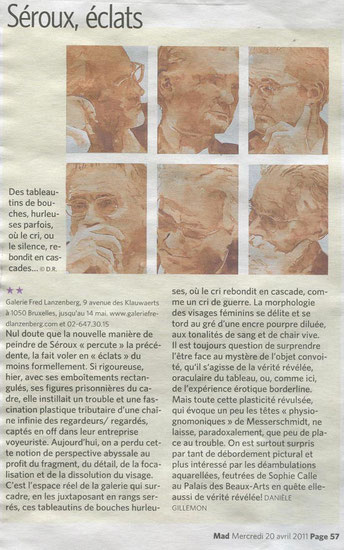
ECLATS
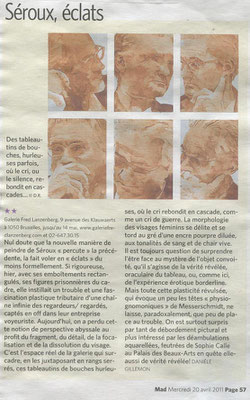
There's no doubt that Séroux's new way of painting 'shatters' the previous one, at least formally. In the past, it was so rigorous, with its rectangular interlocking, its figures imprisoned within the frame, that it instilled a sense of confusion and plastic fascination that depended on an infinite chain of viewers/viewed, captured off camera in their voyeuristic endeavour.
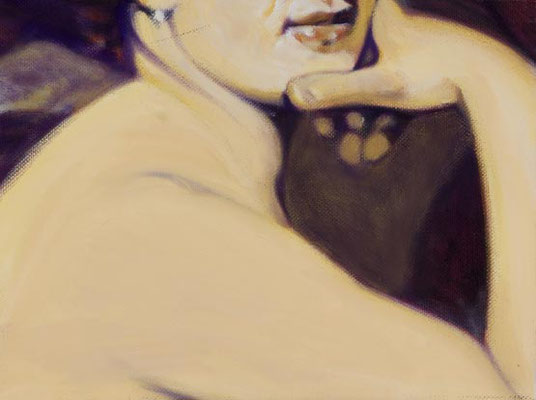
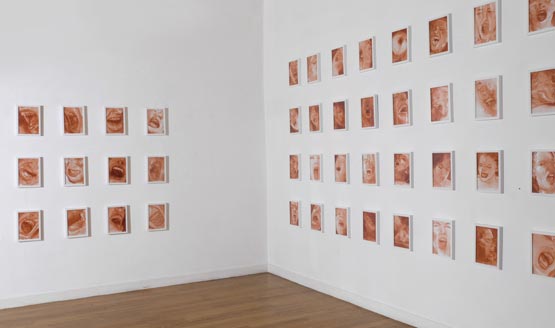
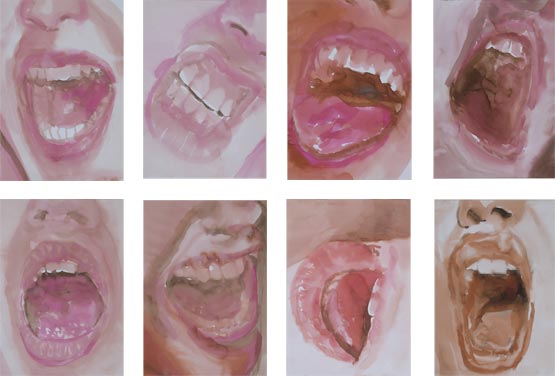
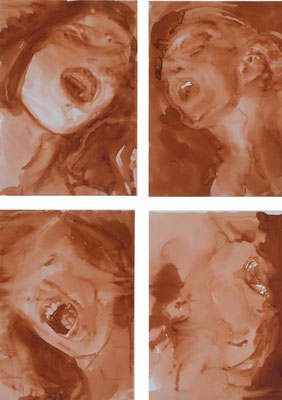
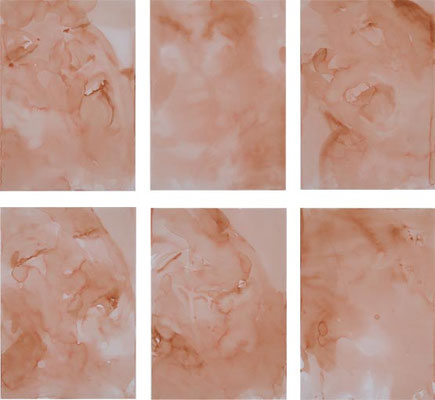
Today, we have lost this notion of abyssal perspective in favour of the fragment, the detail, the focus and the dissolution of the face. It is the real space of the gallery that frames, juxtaposing them in tight rows, these tableaus of screaming mouths, where the scream bounces off in a cascade, like a war cry. The morphology of the female faces disintegrates and twists in a diluted crimson ink, with tones of blood and living flesh.
It's always a question of surprising oneself in the face of the mystery of the coveted object, whether it's the revealed, oracular truth of the painting, or, as here, the borderline erotic experience.
But all this revolting plasticity, reminiscent of Messerschmidt's 'physiognomonic' heads, paradoxically leaves little room for confusion. We are surprised by so much pictorial overflow, and more interested in Sophie Calle's hushed, watercoloured wanderings in the Palais des Beaux-Arts, also in search of revealed truth!
Roger Pierre Turine
CRUSH /
21.10.2021 > 06.03.2022
Unexpected encounters
between design and art
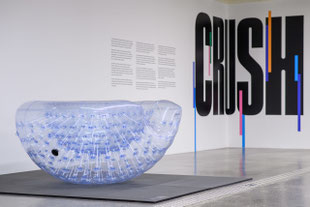
The Design Museum Brussels and the Musée d'Ixelles are embarking on a rhythmic and spontaneous pas de deux with the Crush exhibition, which brings together pieces from their respective collections.
In response to an invitation from Design Museum Brussels, the Musée d'Ixelles (currently closed for renovation and extension work) is bringing out a selection of paintings, sculptures, photographs and other drawings from its storerooms to create happy connections and special accointances with the Plastic Design Collection.
This unexpected dialogue between design objects and works of art underlines the singularity and variety of the two collections, which are revealed in a whole new light.
Nothing
Could this title be a reference to the 'nothings' that make up our daily lives, our solitary intimacy: a sip of coffee, a ray of sunshine on the face, a gentle breeze like a caress, a sigh, a look. Or a cigarette in an art-filled living room.
A moment of contemplation? Melancholy? Or simply quietude? The artist skilfully plays on a probable moment of isolation to fill his work with a hushed, enveloping silence.
Combined with this special moment, the colourful range of ashtrays by Hiroko Takeda and Andries Van Onck punctuate this crush with a burst of joy.
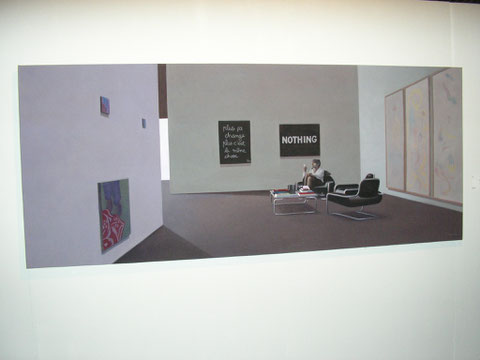
Nothing
1999 Acrylic on canvas
Collection of the Musée d'Ixelles / Brussels
