

A RELATIONAL
AESTHETICS
RELATIONAL
ART
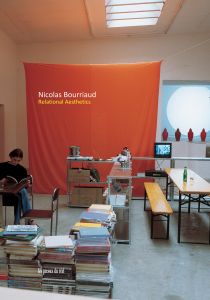
Relational art is a concept linked to, but not limited to, that of "relational aesthetics," the title of an essay by Nicolas Bourriaud published in the 1990s.
These artistic forms take as their theoretical and practical starting point the entirety of human relationships and their social context.
What is at stake are the relationships between the social body (the public, for example) and the interaction with artworks (installations, performances, etc.). This manifesto has renewed the approach to contemporary art.
RELATIONAL
AESTHETICS
Here, however, the relational mode is very different from that conceived by Nicolas Bourriaud, even though one element remains present, as he wrote at the time: "Art is a state of encounter."
In this case, it is the different elements of each work that meet and question the viewer, since all interpretations are open.
PAUL QWEST
THE CURATOR
OF THE COLLECTIVE
Depending on the research and concepts addressed,
Paul Qwest gathers documentation and various objects
which become part of his installations.
THE QWEST
COLLECTION

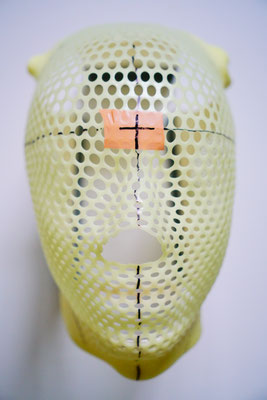
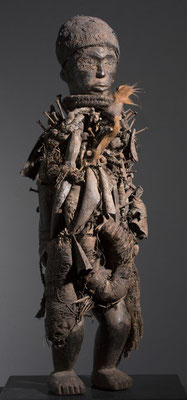

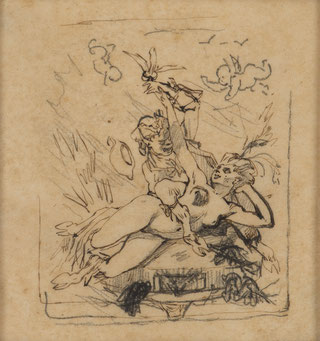

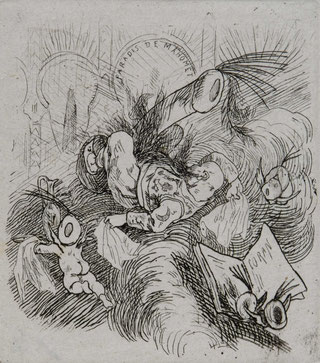
CONNECT
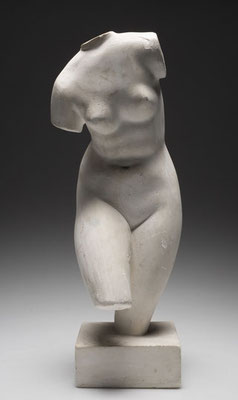
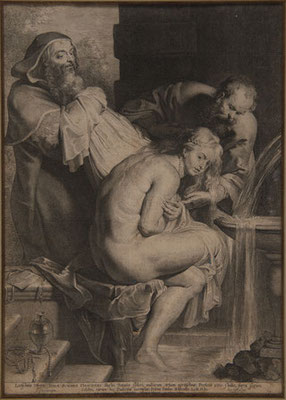
Paul Qwest's unique approach lies in its purely conceptual function. It consists of connecting the diverse works of the five members of the collective to create "archipelagic" pieces composed of multiple elements.
The numerous relationships between these elements inevitably lead to a diversity of possible meanings. One thinks of the Flemish tradition of polyptychs, or the Italian tradition of Giotto with his narrative frescoes, or the use of montage in cinema.
If this Pilpul (sharp debate) is initially a method of reasoning consisting of the study and discussion of the Talmud, this relational exercise implemented here is visually and materially translated into polyptychs.
In philosophy, doesn't reflection also resemble this when it comes to examining our scattered thoughts in order to establish links between signifiers? Henri Bergson, upon discovering the art of film editing in his time, spoke of the "cinema of thought."
Here we are.
ART OF
a CURATOR
To bring together and orchestrate
Since writing the book, Paul Qwest has established a coherence between paintings, drawings, photographs, questions, and various objects that form the raw material of this work. These meaningful ensembles "create a work" and thus become inseparable.
That which constitutes " art"
The aim is to open up the dialogue between the components, much like the juxtaposition of words in a sentence presents the mind with the question of the possible meaning(s) of that sentence.
COGNITIVE CONSISTENCY
The connections that Paul Qwest establishes create a "consistency," similar to the principle formulated by Leon Festinger in his theory of cognitive dissonance. This involves establishing cohesion between attitudes and behaviors in response to various pieces of information. This mechanism refers to the mind's tendency to create narratives.
INTERNAL NARRATIVE
Daniel Schacter's research on the construction of identity deals with the "self-narrative." These "narratives" shape our identity in order to maintain a polished, coherent image over time and across social spaces. Here, Paul Qwest plays, in a musical way, with the senses that are invited and crystallize in the viewer's mind.
POETICS
OF RELATION
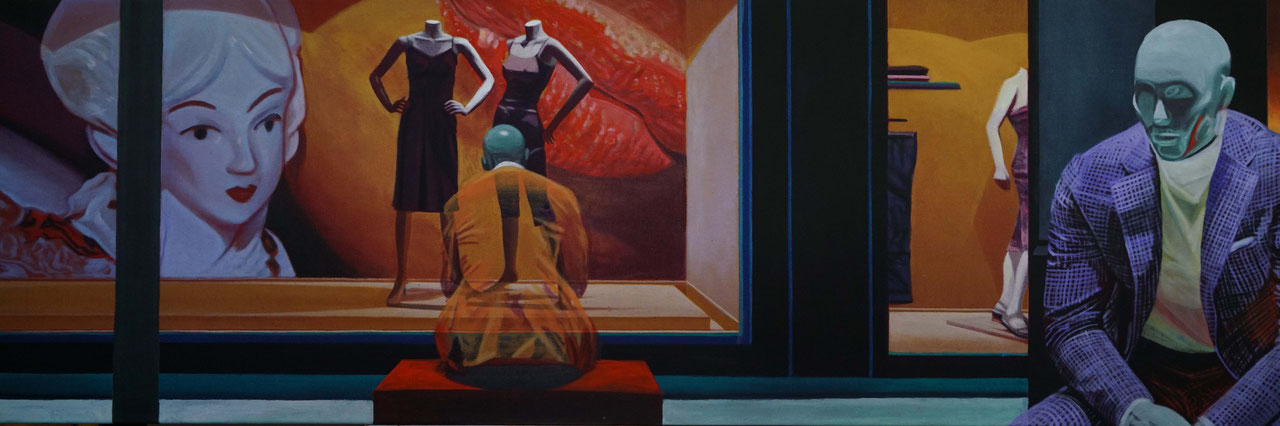



Out of self-indulgence
2013 - 2018
3 elements /
Seroux
1 painting 60 / 180 cm
Ghabor Collection
2 photographs
Somexki Collection
1 photograph
I am made of parts that can fit into many mechanisms; and of elements that compose an infinite number of combinations.
Paul Valéry
An aesthetic
The writer Harry Mulisch noted our common, slightly conservative tendency: "When visiting someone, you always sit in the same place you sat the first time."
Far more details than we realize follow this tendency, this memory. We go where we've already been, we do what we've already done, we see who we know. Recognizing this inexorable numbness is already a way to counteract it, at least a little.
A sense of memory
Each location within certain works opens up a space for thought.
One thinks of the method of loci (places in Latin), the Palace of Memory, or mental palaces. This art of recollection has been practiced since antiquity. It allows us to structure long lists of contemporary elements on the foundation of memories of the places to which we associate them. A vast mental landscape then emerges, unfolding a philosophical diversity of infinite richness...
AGAINST ESSENTIALISM AND
THE ESSENTIALIZATION OF OTHERS


Essentializing something or someone means reducing (an individual, for example) to a single dimension, which is a reduction of reality. Essentializing means applying a single, deliberately biased label. It also often involves reifying reality, that is, transforming and reducing an individual, a work of art, etc., to the status of an object.
Example: Foreigners, women, men, whites, blacks, artists, nobles, commoners, Jews, Van Goghs, abstracts, ... Impoverishment is systematic.
What matters is not the things themselves, but the relationships between them.
Denis Podalydès, quoting Pierre Bourdieu.
Everything is relational.
Contrary to essentializing the world, considering the relational aspect of what constitutes us shows quite simply that everything only has true meaning in relation to something else, in a connection, in a context that is always particular and changing.
The work here stems from this relational evidence.
Therefore, I call beautiful everything that contains within itself the capacity to awaken in my understanding the idea of relationships.
Denis Diderot
A TANGO WITH NUANCES
The needs and dangers of life generally ensure forced mobility, but if the environment is comfortable, natural inertia (that which maintains a body in its state in the absence of an external cause) risks insidiously fossilizing us.
There is no more useful attitude than to get moving again, to follow an external soundtrack that invites you to shake up everything that is not stone.
It's about putting the mind in motion, choosing everything except a home, pushing the head to the antipodes, going where the arrow is going, drawing the target afterwards, and being surprised at having aimed so well.
IN OTHER WORDS
Tilt
Many realize late that an arrow's destiny is to fly
and not to care.
Roberto Juarroz
Elastic
The philosophy of the relationship would not only be an art of wandering but literally a wandering philosophy, whose poles and points of exchange would constantly move.
Édouard Glissant
Dancer
I am a man of movement for whom immobility is a constraint.
Waslaw Nijinsky
Shade
I don't evolve: I travel.
Fernando Pessoa
Locomotion
Think ! Rather act on my machine of being (and thinking) to find myself in a position to be able to think new, to have possibilities of truly new thoughts.
Henri Michaux
From the front
Fear is a passive state, and the goal is to be active and take control, to be alive in the here and now.
The movement is from passive to active, because if the past is not denied in the present, we do not live.
Louise Bourgeois
Weird
Wandering thought is a special faculty.
Samuel Beckett
Perpetual motion
All art is a search towards the same goal; if we ever reached it, it would be over; there would be no more art, everything would be frozen, immobile, absent.
However, in nature, everything is mobile, everything is possible.
Alberto Giacometti
Meridian
Here are the interior landscapes of a man long gone to the pole of himself.
André Breton
Kayak
Let us not waste time analyzing our thoughts, on the contrary try to row further, to keep the pen (like an oar) perpetually in the current, in order to make an exact transcription of the passage.
Henry David Thoreau
On Pushkin
Not a day goes by without this force, this itinerant inspiration, creating some instantaneous performance here or there.
Vladimir Nabokov
A CHORAL
WORK
THE VIEWPOINT
OF PSYCHIATRIST
ERIC BERNSTEIN
Each state has its own characteristic thoughts, feelings, and behaviors. Analyzing the interactions between these three states allows us to understand the cognitive subtleties of personal and interpersonal dynamics.
The verbal and nonverbal relationships between these ego states constantly enrich our relationship with the world, with others, and with ourselves.
Eric Berne also developed the concept of "psychological games," which occur when individuals, who may be more or less rigid in their thinking, cultivate repetitive behavioral patterns based on beliefs and unconscious, often destructive, normative scripts.